Category: News

  • Create Your Day

    Create Your Day

    Creating Your Day the moment you wake up changes neurological pathways
    You are that powerful!
    Create Your Day is a powerful technique that not only changes the brain but changes your experience of the world around you daily and what you attract.
    In an environment where many of us are trying to regain hope, humanise the digital age and stay connected with the true nature of oneself and to each other, “Creating Your Day” gives you hope brings about changes. It creates bigger changes the more you practice the technique.

    Have you noticed that from the moment you wake up your brain searches for old memories, the list of what you have to do, how you feel about yourself, family, your work situation; in other words old neurological pathways. What if the moment you woke you changed what your brain thought? How do you think your day would be if you changed your thoughts the moment you woke?

    How to Create Your Day

    The moment you wake up take a moment to connect to what you really want from your day. What would make you happy having experienced at the end of the day looking back? Feel into how that would be if you experienced this. Then create announce to the day: “Today I will experience…..(add your order here).” ie ‘Today I will be meet new people”, “Today I will experience abundance like I have never known it, and all along the way I will be delighted by the day”.

    Remember to only create what you are prepared to live!


    This is not about changing habits as such rather it is about honouring that life says “YES” to our intentions from the moment you wake up, so let’s change our thoughts then get on with living.

    “Today I will experience…….”

  • Healthy Mind; The Basis to Change Habits Successfully

    Healthy Mind; The Basis to Change Habits Successfully

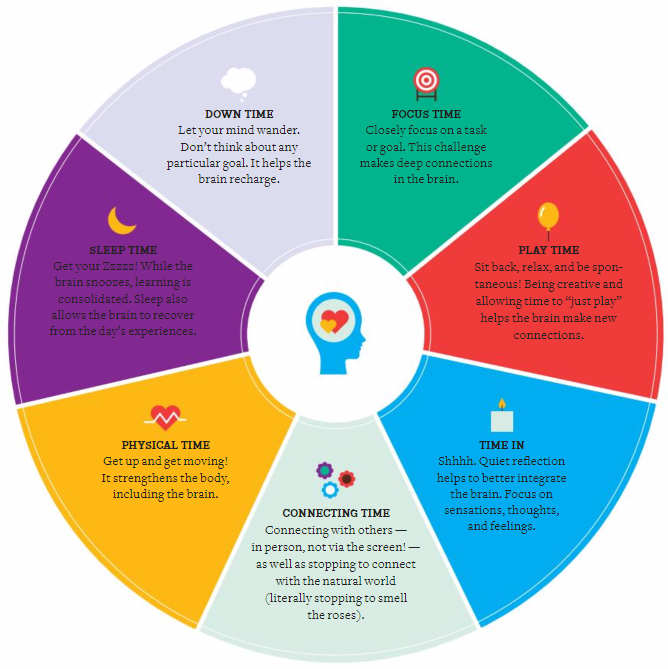
    The Healthy Mind Platter is a great foundation to start the year. Get this right and the body and healthy habits will follow.

    New Year’s resolutions are fraught with failure, yet if we look at ourselves holistically then we can begin to develop healthy habits. The healthy mind platter developed David Rock and Dan Seigel gives a fundamental framework to develop rituals that are sustainable.

    “The Healthy Mind Platter has seven essential mental activities necessary for optimum mental health in daily life. These seven daily activities make up the full set of ‘mental nutrients’ that your brain needs to function at it’s best. By engaging every day in each of these servings, you enable your brain to coordinate and balance its activities, which strengthens your brain’s internal connections and your connections with other people.

    Elements of the Platter

    The seven essential daily mental activities are:

    1. Connecting Time: When we connect with other people, ideally in person, or take time to appreciate our connection to the natural world around us, richly activating the brain’s relational circuitry.
    2. Physical Time: When we move our bodies, aerobically if possible, which strengthens the brain in many ways.
    3. Time In: When we quietly reflect internally, focusing on sensations, images, feelings and thoughts, helping to better integrate the brain.
    4. Play Time: When we allow ourselves to be spontaneous or creative, playfully enjoying novel experiences, which helps make new connections in the brain.
    5. Focus Time: When we closely focus on tasks in a goal-oriented way, taking on challenges that make deep connections in the brain.
    6. Down Time: When we are non-focused, without any specific goal, and let our mind wander or simply relax, which helps our brain recharge.
    7. Sleep Time: When we give the brain the rest it needs to consolidate learning and recover from the experiences of the day.

    Your Healthy Mind Platter Exercise

    1. Outline the elements of the healthy mind platter and needs
    2. Brainstorm ideas for each element, allowing the ideas to simply flow without analysing. Write them down.
    3. Evaluate Solutions that meet your needs
    4. Choose solutions and times of the day that are most suitable for you to do this
    5. Implement Solutions
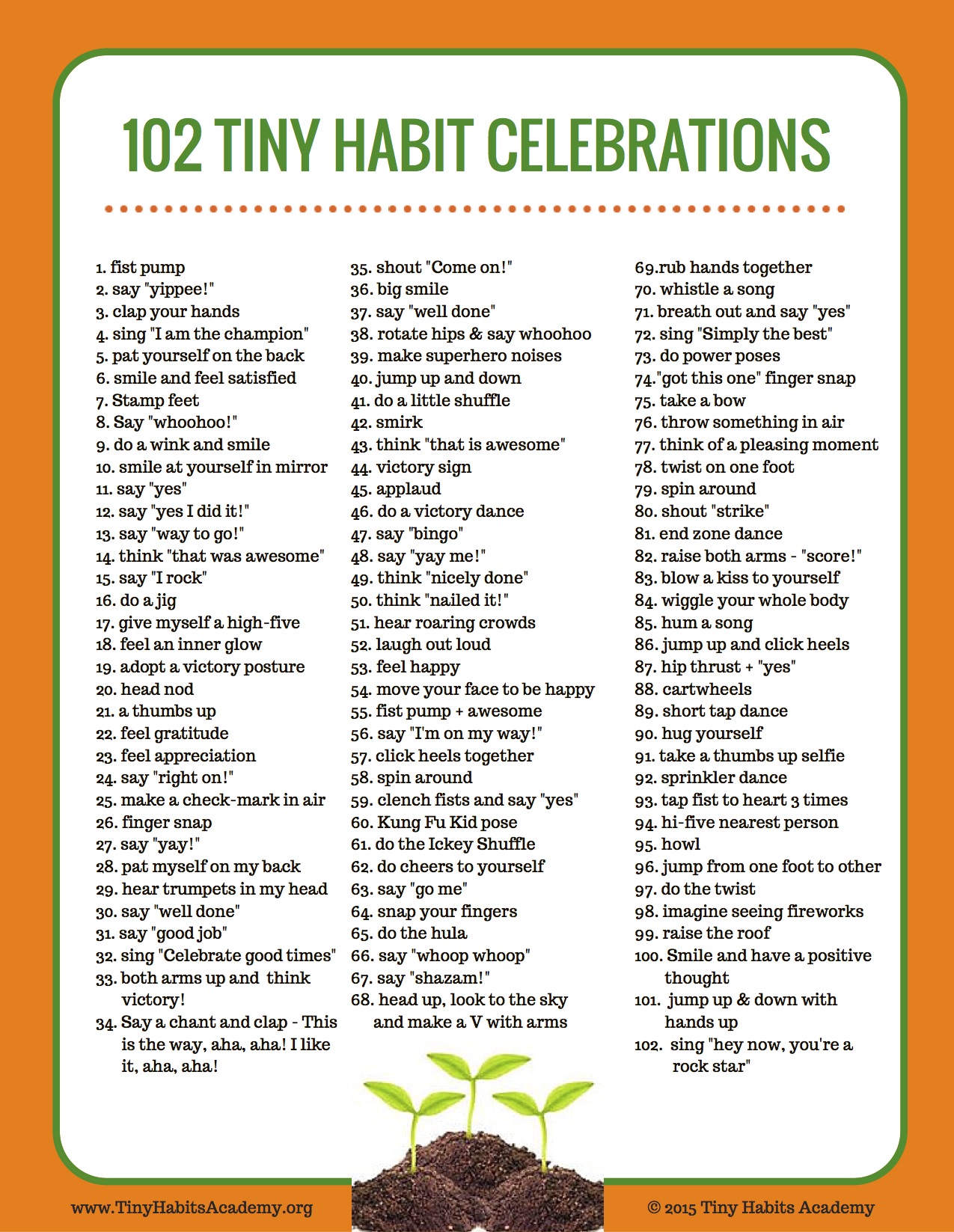
    6. Celebrate Your Victories after every solution implemented. Remember you are changing the brain, and body – so take time to celebrate your awesomeness. Here’s a few ideas: https://www.wellthyboss.com/tiny-habits-w-bj-fogg-linda-fogg-phillips/
    7. Check Results weekly – make a time each week to check in and evaluate whether the solutions need to be updated
    102 Tiny Habit Celebrations

    Start with Tiny Habits

    We are bound to fail if we set our goals too high too fast without clear ideas how to support the habits changing and reinforcing the changes. We may have the motivation to start with but not the ability to do it or the trigger to develop the habit.

    BJ Fogg outlines 15 ways to change behaviour over a long term period https://www.behaviorgrid.org So of these ideas are:

    Fogg Behavior Grid (with examples)
    1. Modify your environment: includes your social, work environment
    2. Make the habit small to start with so that training your body brain to make a habit automatic
    3. Design not for the outcomes but the behaviour that leads to the outcome, therefore the healthy mind platter is a start to assist this. For instance weight loss there are many behaviours the contribute to the outcome ie stress reduction, eating habits, etc. Creating tiny habits change the end outcome.
    4. Three things that need to happen to create behaviour change – High Levels of Motivation, ability to do it, Trigger (call to action). These three things together create change.

    Develop your Own Format

    Including Motivation, Ability and Trigger to develop a new habit you may want to try this:

    “After I (existing habit – trigger)………., I will (new tiny behaviour)…………”

    Following on from a habit you already have then add a new behaviour.

    Tiny habits might be: “After morning coffee I tidy something in the house”. “Every time I walk in the door I will hug my partner”. “I will walk to work from the previous train station”

    Remember to celebrate, find one that works for you, after every behaviour that you have changed. The more you do it the more you automate the behaviour.

    Combining the Healthy Mind Platter enables you to look at your life, look at what you want to change, break it down into tiny behaviours and put it into right spots in your day combining triggers to remind you, and the behaviour will naturally grow.

    Sharing Success

    To support those tiny habits changing we would love to hear how you have gone, how you celebrate the little changes and your awesomeness. Add comments below……

    _________________________________________________

    References

    Seigel, D & Rock, David., The Healthy Mind Platter https://psychologyonhay.com.au/wp-content/uploads/2020/04/POHHealthyMindPlatter.pdf

    Fogg, B. J. (2012) ‘Forget Big Change, Start with a Tiny Habit’ TedXFremont YouTube https://www.youtube.com/watch?v=AdKUJxjn-R8

    Fogg, B.J. ‘Tiny Habits’ https://www.blinkist.com/en/books/tiny-habits-en#:~:text=Brief%20summary,blueprint%20for%20sustainable%20behavior%20change.

    Fogg, BJ. ’15 Ways Behaviour Can Change’ https://youtu.be/Sd7xx1n3dl8?si=gCEHnjRZzBTx6W3A

    Fogg, B.J. & Fogg, Linda ‘Celebrating tiny Habits’ https://www.wellthyboss.com/tiny-habits-w-bj-fogg-linda-fogg-phillips/

  • The Key Word is Connection

    The Key Word is Connection

    DO YOU REMEMBER WHAT YOU GOT FOR CHRISTMAS LAST YEAR?
    Most of us cannot remember what we got for Christmas but we do remember the vibe of the gatherings, the connections made, the stories told around the table and the feelings generated. We remember the love, the arguments, the hope, and quirky things people did. Our relationships are the reason we celebrate Christmas! They are also the best measure of health!

    So a few tips to help connect with each other this Christmas:

    1. Remember behaviour is always trying to get a need met. So listen for the need and feed it back to the other and usually the behaviour stops. ie: “It sounds like you really value being heard around this issue?’ (need = support, acknowledgement, being heard, understanding etc – not a solution, as much as your brain may like to analyse). Also you have needs that staying close to yourself and giving yourself some empathy will help you verbalise these too.
    2. Remember no one modelled to us secure functioning relationships!Your parents never had modelling too. So start a trend by sharing your self empathy ie ” I am excited to spend Christmas with you, as I have missed you”. Or “I am really nervous about today as social gatherings usually make me uncomfortable, so was wondering if we could do it differently? I have brought games would you be interested in playing?’ 
    3. Repair quickly. Conflict that is not repaired goes into long term memory, so the thing that will be remembered next Christmas is that argument. So if you stuff up, apologise and repair it. Remember it is not repaired until it is repaired.
    4. Emotional Indulgence – check yourself at the door. If you can regulate your nervous system outside of the home, or when a friend is in your home then yelling, hitting, the silent treatment or any form of abuse is simply an emotional indulgence. You are responsible for how you respond. So a tip, ask yourself this: “Would I speak to a family member in this way if my best friend was standing beside me?” If not don’t do it!
    5. Set Your Intention. What kind of Christmas would you like? How would you like to feel? Set your intention for the day, the holiday, the festive season. Feel into it and let the festivities bring about your desires. It creates a little magic over Christmas and you deserve it!
  • Connection Rituals – Keeping the Juiciness Alive in Relationships

    Connection Rituals – Keeping the Juiciness Alive in Relationships

    One of the questions asked in couple therapy is what connection rituals do you have? Keeping the juiciness of intimacy alive is paramount in sustaining couples in their challenging and stressful, worlds. 

    Maintaining a secure functioning relationship means taking care of the relationship with the understanding that ‘love is a verb’, as Esther Perel would say.

    The avoidant-anxiously attached partner would normally run at the idea of ritual, as they often feel trapped and swamped by commitment, yet connection rituals free up time for more alone time. Rituals reduce the amount of avoidant’s deactivating strategies such as focusing on small imperfections, flirting with others, pulling away when things are going good, checking out mentally and avoiding physical closeness.

    For the ambivalent-anxiously attached partner these rituals reduce protest behaviours such as excessive attempts to re-establish contact, punishing by withdrawing, keeping score, acting hostile, threatening to leave, manipulation and making the other feel jealous. These connection rituals soothe their fear of abandonment, relieving their nervous system to then allow more space in their life and their partners life. 

    Rituals are supportive for both partners nervous systems and essential in keeping the relationship connection alive and juicy.

    THE BASICS

    These little daily rituals create a big difference in relationships. We often create conflict due to the way we move towards and away from each other, it’s not personal, we are simply wired to each other for our survival. If partners do not manage these movements they start fighting due to the ruptures created and the need for connection or space.

    1. Launching the Day – What is one thing that you can do that creates that juicy connection with each other at the start of each day? For example: eye gazing in bed, coffee on the deck, a shower together, a morning walk, making love. Negotiate and agree upon a ritual that you both commit to every morning. As an avoidant I often feel like squirming out of this one as I like to go running or swimming early in the morning, disappearing into my own space, but I pay the price in my relationship if I do. I miss the juicy connectedness that energizes me for the day. So if you have an avoidant partner give them an escape route ie; “I don’t want to stop you from your day, you just need to give me a hug before you go”
    • Welcome Home Hug – Our worlds are busy, there are a lot of issues to deal with throughout the day, decisions we have to make and pressures put on us creating stress. Calling upon each other to recalibrate ourselves from the demands of the day ensures we do not bring the stresses into the house and emotionally indulge in trying to get the feelings out. So the first thing on arriving home is to seek the other out and give each other a ‘Welcome Home Hug’. This is a hug where you don’t let go until the other is completely relaxed. One way of doing this is to relax your own nervous system and the other begins to relax (in this way we are using mirror neurons to recalibrate each other’s nervous system). “If In Doubt Hug it Out”
    • Landing the Day Together – Soothing each other’s nervous system in the evening can include putting each other to bed, watching a movie together, walking in the evening, reading together, discussing your day. If you are parents with children, allocate a space in the house that when you are seated there you are not to be disturbed, unless it is very urgent! Discuss and negotiate this ritual with each other as it has to work for both. Also note that going to bed at the same time together means that you regulate each other’s nervous system so the one that usually is a night owl often finds they sleep better.

    The key in establishing these rituals is the commitment by both of you in the relationship. If there is a mutual agreement then both are responsible for upholding it. If there is no agreement come back to the drawing board and find what works for you both. If one partner is not interested, you have a problem in the relationship being tipped towards ‘pro-self’ rather than ‘pro-team’. 

    Secure functioning relationships are based on mutuality, fairness, justice and sensitivity. 

    The motivation is that secure functioning relationships allow you both to be better in the world, achieve more, hold more, play more and work effectively as a team whist protecting each other in public and in private. Isn’t that the reason you are in a relationship? Remember, this is a ‘We’ gig not a ‘Me’ gig.

    THE JUICE

    Giving time for weekly rituals sustains your relationship so it sustains you, despite what an avoidantly attached partner thinks. It frees up resources to be able to be better in the world and with each other.

    Ideas for rituals throughout the week could be

    • Eye gazing (Soul gazing)– We all want to be seen, to feel as though we matter and thrive on secure connection. “I see YOU, you have my full attention” is portrayed in taking the time to really look at each other and breathe each other in. 
    • Random acts of affection – Long passionate kisses, flirting etc in private or public – check whether your partner is comfortable with signs of affection in public. This can be done whilst passing in the hall, or coming out of an office into the house and family.
    • Shared Hobbies – what do you love doing together? Make time for this on a weekly basis.
    • Plan for quality time over quantity – Saying when you need ME time/space or more connection. Negotiate connection and space from each other. Remember behaviour is propelled by needs. Therefore ask when there is a need for more connection or space rather than fighting for it.   
    • Making a meal and enjoying it together, switching off phones and screens just enjoying each other’s company.
    • Cuddling in bed – Even when tired, making the effort to physically connect and hold each other. 
    • Radical Honesty – Energy is wasted by not being truthful. Relationship WE checkups. Not to be done in bed, find a space to do this and meet once a week. A question to ask is: How can I be better in our relationship? What have you loved me doing, or being this week?
    • Exercise Together – What do you both like doing together? Create something and do it regularly. Examples are biking walks, kayaking, swimming followed by a meal a few times a week.
    • Dates – whether it is for coffee, breakfast or dinner or pleasure pauses throughout your work day, make time for novel experiences throughout your week. It amplifies your connection and creates great stories
    • Games – there are a number of couple adventure or bedroom games. Add laughter and adventure into your relationship.

    One of the myths we have is the difference between co-dependency and interdependency. Interdependency does not sacrifice an individuals needs. Rituals give us the inspiration, love and energy to be better in the world as it shores up resources. 

    FESTIVE SEASON RITUALS

    • Watch each other’s favourite seasonal movies or shows 
    • Prepare a themed meal and enjoy it together, distraction free 
    • Take a walk around your neighbourhood and admire the Christmas lights and different stress decorations 
    • Find a local volunteer opportunity to start together or contribute to over the festive season
    • Start a two-person book club and read a book together 
    • Share what you’re thankful for with your loved ones 
    • Create your own festive season tradition!

    A FEW STEPS

    How are you going to revitalise, nurture and keep your connection alive over the new year?

    Make time to discuss what connection rituals work for you both.

    Set them up and trial it for a week and then review at the week what works and what doesn’t and alter accordingly.

    Keep creating rituals that take care of the relationship and the “WE” gig.

  • A Story of Healing

    A Story of Healing

    (Trigger warning about growing up with domestic violence)

    For 15 years, I found myself trapped in a relentless cycle of physical and emotional abuse between my parents. I spent my childhood protecting my mother and living in constant fear of my father. Strangely, I never considered my childhood traumatic; I believed it was normal to ask my friends if they feared their dads. This secret burdened me for a long time – concealing the bruises, losing sleep at night, and allowing anxiety and panic to consume me until it overflowed like sticky, black sludge, devouring everything in its path.

    Throughout my childhood, I constantly placed myself between my parents, a young girl attempting to pry her father’s hands from her mother’s neck. Even though I was the youngest, I played the role of the adult, mediator, and counsellor, striving to maintain peace for everyone’s safety. But I had no one to turn to for my own well-being, and these early experiences still affect me in my daily life. I’ve struggled with my relationship with myself, as I was taught to neglect my feelings, believing that showing emotions meant I would be hurt. Growing up, I didn’t have my needs met, except when I was sick. Despite our outward appearances of wealth and privilege, my family lacked the core needs of love, safety, and connection. This is why I’ve developed a complex belief around money and success, as I’ve come to understand that material wealth doesn’t necessarily fulfill these fundamental needs.

    Most of my adult years have been dedicated to learning how to be the parent I needed for myself, creating a relationship of self-love, nurturing, and daily self-care. This is something that does not come naturally to me, and it takes a huge amount of discipline and work to tend to myself, and being able to drop in with myself to understand my needs and feelings is a daily struggle. 


    I’ve noticed the patterns, stories, and beliefs I’ve inherited from both my parents, a painful inner critic capable of tearing me apart in seconds, a gift from my father who raised me to believe love had to be earned through accomplishments and criticism. My mother gifted me worry, fear, shame, and mistrust, as she was emotionally absent most of my childhood. She cared for us physically but was often angry or crying. She would constantly make us choose between her and our father or threatened us with our father if we misbehaved. She’d panic when he would return home, making us scramble to tidy up, prepare his dinner, fetch his whisky, and serve him. She would talk to me about all the things he did to her, seeking comfort, I was often her mother as she broke down.

    School offered no refuge; I faced bullying, struggled with the material, and often felt confused and displaced. I dreaded going to school, the stress it caused, and the isolation I felt there. As an adult, I still experience that stress when studying, doing assignments or tests, my body dysregulates, and my brain switches to survival mode. I struggle to absorb information and become overwhelmed and anxious. I’m still working to understand this part of myself, its origins, and what it needs. I think it might be my father’s pressure to excel, or face shame and bullying, drilled a fear of failure in me.

    When we moved from South Africa to Australia, I was at the age of 7, things deteriorated further. We became more disconnected and isolated from our support system, family, and friends. None of our family had left South Africa before. Starting in a different place intensified the violence at home, making my father’s temper and emotional abuse as violent as his physical actions. In reflection, I realize this move perpetuated the patterns of disconnection, isolation, and separation that lies within our family’s history. 


    I spent most nights that they would fight, waiting for my parents to fall asleep before I could. I’d even make a makeshift bed outside their door during school nights, keeping watch without their knowledge. Noise still makes it difficult for me to fall asleep; my body panics, relapsing back into old, trusted survival mechanisms.

    I’d often pretend to be sick, to get out of school and I was also just generally an unwell child. I held a deep belief that I needed to stay home, encase my dad would come home and harm my mother while I was at school. This was my biggest fear growing up, that he was going to hurt her so badly or kill her and hide her body and I would never see her again. 

    Mornings consisted of waking up anxious, as I lay in bed, uncertain whether I’d hear yelling or whistling, not knowing which version of my father he would be that day. I’d experience what I called “bad feelings” from a very young age. I always had a sense that something terrible was going to happen at home. I still carry this hypervigilant awareness, waves of dread or fear washing over me, paralysing me at times and sending me into a hypervigilant survival state. I can become extremely panicked and stressed by the smallest of things, the moment I do not feel in control of my home surroundings my body will go into a fight and flight response, I often stay here until I breakdown or become sick. 

    Getting my dog, Gina, was my number one resources during my childhood. She offered me an escape, companionship, and the unconditional love and safety I so desperately craved.

    I despised the coverup of the happy, perfect family we presented, particularly when guests visited. We’d stage scenes of an ideal family with fine China, elegant cutlery, and classical music, complemented by my father’s elaborate stories. He played the part of a showman, projecting confidence, humour, and intelligence while concealing the terror he unleashed behind closed doors. I learnt how to adopt his masking abilities, though I used mine to hide the parts of myself I dislike, my trauma, sadness and anger. As I grew older, I experienced the same slips where the mask would crack, revealing what lay hidden beneath. 

    The shock of my father’s first (known) affair marked a significant turning point in our lives. For the first time I witnessed my parents’ showing affection to each other, I watched as my parents tried to repair their relationship, sitting side by side, holding hands on the couch. All I felt was disappointment in my mother and her weakness for forgiving him, given all my dad had done. I didn’t understand what was happening and their attempts at affection made me sick and angry. This triggered the first episode of my long journey with depression, a period when I finally submitted to the weight of it all.

    I remember telling my mum I thought I was depressed, and her dismissing it “don’t be stupid, you’re too young to be depressed.” So, I sat by the pool at night with a knife in hand, hoping to end it all. I was only 12 years old at the time. I’m still uncertain about what pulled me out of that state, but I think I had started to make a solid group of friends around that time, they provided an escape into their normal lives and homes.

    One of the most challenging aspects of reflecting on all this is that I loved my father. I loved the funny, gentle, and kind side of him. We shared a strong bond, we laughed, joked, and teased each other. I inherited my sense of humour and playfulness from him. I always wanted to impress him. I was the one forced by the rest of the family to enter his office when he got home and change his mood, to make him laugh.

    When I was 14, we moved to a new house and suburb, hoping for a fresh start and a change in my parents’ marriage. But my mother discovered my father was still having an affair, so they began sleeping in separate rooms. Their mind games and mutual hatred became an addictive cycle. Eventually, my father received a job offer in Sydney and left home when I was 15. I watched my mother collapse into a lifeless, angry mess. My protective relationship with her turned into one filled with anger and resentment. We fought constantly, and the anger I felt towards her during those years, was more than I ever had my dad.

    After my father moved out, I experienced a newfound sense of freedom I’d never known before. I was no longer controlled; I could wear makeup, decorate my room, use nail polish, choose my clothes and jewellery, and colour my hair without being criticised as pathetic trash or a waste of time and money. I could go out! I was finally free, and for once, I didn’t care what was happening at home. I wanted nothing more to do with my family, and that’s when our family started to completely fall apart.

    During my parents’ separation, I found a distraction in my first long-term relationship. It became my escape, a place where I poured all my energy and attention. Those initial six months were pure bliss, and I relished being able to escape to his family home, I was finally apart of a family that felt safe, surrounded by adults who loved each other.

    When my mother and I got into a fight, and she hit me in front of him. He offered me a place to stay, but while staying with him and being in the dysregulated state I was in we got into an argument. My trust issues and the absence of positive relationship models guided me to repeat the patterns I was shown, and I hit him in the face. I still remember the immediate shock and remorse I felt, and still do. From that point on, toxicity and control crept into our relationship. My happiness and security I was seeking so desperately became a burden to him, and he began pulling away, which caused me to go down a path of even more destructive behaviours. I can see after learning about attachment styles how I was searching for love and connection, but if the people I cared about started to pull away or not prioritise me I would punish, blame and try to control them.

    The combination of a toxic relationship, my parents’ separation, our family’s breakdown, and the childhood trauma I carried finally took its toll, and my body gave in. At the age of 17, I fell seriously ill with acute pancreatitis. For over two years, I didn’t have the normal life of a teenager, I suffered violent episodes of sickness, and received warnings about the risks of cancer, diabetes, and other illnesses. This health crisis forced me into understanding the relationship I have with my body and my health, I had to learn how to somehow manage my stress and anger, while creating a state of healing for my body.

    During this challenging period, my sister moved back home and became my anchor. She was studying naturopathy and played a vital role in my healing journey. My relationship with my boyfriend finally ended. My sister became my primary support as I grappled with sickness, exhaustion, and brokenness.

    Unfortunately, our close relationship also meant we experienced extreme highs and lows, swinging from being inseparable to intense fights. One particularly heated fight ended with me punching her in the face after she scratched and attacked me one afternoon. This marked the end of our relationship for many years. My brother also moved out of our home due to our frequent violent conflicts, as we all mirrored the modelling we had observed from our parents.

    As soon as I turned 18, I moved out of home and found my escape in traveling and running away as soon as things became difficult. I struggled during these years, getting into fights with anyone who tried to control me, I would fight with bosses and leave most workplaces on a bad note. I would fight with close friends, moving in and out of people’s houses. I was completely disconnected from my family and wanted nothing to do with them, I would spend Christmas with friends and distracted myself with partying or seeking out the next place to escape to. When I was home briefly in-between moving to the next destination mum and I would have horrible fights, I would speak to her just like my dad would. Trying to put her down and break her, I had so much anger and resentment towards her. After I started studying naturopathy, which triggered of enormous amounts of stress and overwhelm in my system that I was constantly sick and struggling to cope, I moved back in with mum. We moved to the Mornington peninsula together and tried to reconnect. It was chaos. I blamed her for everything and all I had was resentment and anger towards her, I was the one stuck with pain and struggling and she was fine. I had given up my whole childhood to keep her safe, and she never once protected me. Her attempts to mother me or be there for me as I was becoming an adult only infuriated me. 

    I found a group of friends during this time that I finally for the first time in my life felt completely accepted by, they opened my eyes to a new world, and this was the turning point for me to turn towards everything I had been running away from. As they had trauma like me, they were broken just like me. We all began a long journey of trying to understand our childhoods, we experimented with psychedelics, partied a lot and tried to understand our emotions as we went through waves of depression. I met my current partner through this group of friends, and all the things I had been running from came back and hit me like a ton of bricks. I watched as I started to fall into all my unhealthy coping mechanisms, my triggers and patterns unravelling themselves at an alarming rate. He was like a rock during those times, I was a wave of insecurity, jealousy and fear crashing over him, again and again. 

    It wasn’t until I reached the age of 26, after moving into a household with my partner and another couple I was close to, that I truly began to recognize how my childhood experiences were affecting me. It was the first time I had lived with males since my dad, and it triggered a deep descent into a very heavy depression. I was riddled with anxiety, my protective mechanisms rearing their heads as the parts of me that didn’t feel safe started to act out, searching for some form of acceptance. My thoughts consumed me, turning me into a vortex of destruction. I started to struggle in my relationship, and our housemates eventually moved out because they couldn’t cope with being around me. This cycle of chaos and destruction persisted, no matter how hard I tried to escape it, always lurking in the patterns I had carried since childhood, waiting for the right triggers to set it loose like a wildfire.

    After two years, multiple housemates and finally coming out of my depression, my partner and I decided to move to Tasmania, I was secretly and unknowingly to myself seeking an escape as people began to discover the real me behind the mask I wore, the fun, carefree, bubbly persona had finally cracked. And once again, without me knowing, I was perpetuating the long history of separation and isolation within our family once again.

    Living together in a new place with just him, my trauma started to take a dark turn. I became completely dysregulated, alone, and yearning for love, safety, and connection. My friends and community were no longer there, leaving him as my sole support, my safety person. I turned controlling, argumentative, and passive-aggressive, punishing him for any time he went out or did things independently. Constantly questioning his love for me, becoming hyper fixated on our sex life and how much time he spent with me. Our relationship really started to suffer as we started to fight and argue, I was trying to get my needs met by criticizing and blamed him for not meeting my expectations, wearing him down with my years of testing. I would start massive fights only to end up dreading him leaving me and expressing how sorry I was and pulling at him to resolve our issues. I was a textbook of an ambivalent anxious wave, what I didn’t realise that slowly during the years we had spent together, my actions were turning him into an avoidant attachment. Which meant I just would push more and more, and he would retract more and more. 

    Finally recognizing I really needed help, I started seeing a kinesiologist/naturopath who employed Internal Family Systems (IFS) therapy. With two sessions a week, I began noticing some subtle and significant shifts in myself. I grew less reactive, re-establishing a relationship with myself that I had long neglected during relationships. I delved into self-help books like “How to Do the Work” by Nicole LePera and Stan Tatkin’s “Your Brain on Love.” This new information opened my eyes to the painful patterns I had perpetuated since childhood. I reached out to more therapists, creating a strong support network.

    Some of my friends had taken the Awakening Group course, and I had always wanted to do it, I was just doubtful of when I would be ready. Feeling more resourced and ready to confront myself, I enrolled in the course, bringing me to where I am now.


    “What is possible when we truly feel safe?” 
    Dr Stephen Porges

    Creating my day from a big-picture perspective made me confront my negative thoughts and fear-based beliefs. My mind had been so active in the morning that I hadn’t given myself a chance to consider what I wanted to create. This related to the anxiety I felt as a child when I had to be hyper-vigilant about potential dangers. I held resistance to this work, and even when I tried to create my day, an inner voice would quickly dissolve my desires. Deep down, I held onto the belief that if I expected something good, I wouldn’t be prepared for when something bad happened. This is my internal mother archetype that I carry, that parents me most days. She likes to seek out the fear and worry in everything, always assuming the worst. I know she does this to protect me, but it also greatly limits me.

    Chuck Palahniuk’s quote resonates: “What we call chaos is just patterns we haven’t recognized. What we call random is just patterns we can’t decipher.”

    Learning about ACE scores and toxic stress in “Healing the Wounded Healer” was impactful. It was my first time looking at my ACE score in detail, understanding how childhood trauma and stress had affected my brain’s chemical changes. I became aware of my ego defence mechanisms and got to dive deeper into my attachment styles, realizing how much they shaped my relationship patterns. I have found attachment style very helpful within my relationship, I had always sought others to regulate me, that it was their job to make me feel safe… but now I know that I need to regulate myself first, before seeking out others. Or I can (attempt) to communicate what is going on for me so that my partner knows what is going on.

    Dr. Joe Dispenza aptly said, “Nobody changes until they change their energy. If you change your energy, you change your life.”

    The work of Byron Katie and the simple yet potent idea of meeting reality as it is has helped me to come into a state of balance within my own thoughts and beliefs, I know I still have so much work to do in this area. My mind is like an Olympic sprinter and is very good at critically pointing out all the wrong others do to me; even if it is the tiniest of actions, I will create stories and beliefs that keep me stuck in these protective parts. 
    Learning to stay in my own business has helped me enormously within my relationship. I never realised how much my thoughts were focussed on what others were doing around me. “If you are living your life and I am mentally living your life, who is here living mine? We’re both over there. Being mentally in your business keeps me from being present in my own. I am separate from myself, wondering why my life doesn’t work.” – Byron katie. 

    Physically speaking had to be one of my favourite modules we did all year, learning EFT has been life changing for me. I have started doing it daily, sometimes multiple times a day and have seen such incredible shifts within my thoughts and nervous system. This is a tool that I know I can use to help with my stress and reprogramming my brain. Going more into self-care and learning the importance of looking after ourselves and bodies especially if we have experienced trauma in our developmental years. I know I still get panicked about becoming ill because of my trauma because this is something I do experience. But the EFT is helping me with these stressful thoughts, and I am implementing more self-care through nutrition, movement and seeking more support than I ever have. 

    Effective communication remains to be the subject I have struggled with the most, I can see clearly throughout my life all the time’s my communication has failed me. How I am either passive aggressive or aggressive in my communication. The only time I can actually communicate my needs and feelings is when it has nothing to do with me as a person, if I have to stand up for myself or express myself, I become extremely anxious, if I have a problem with someone, I push the blame and judgement completely onto them. I learnt this from my parents, my modelling was fighting, blame and criticising. I don’t think I ever once was introduced to healthy communication. Even simply identifying what my needs are and feelings has been a challenge within itself. 


    Family constellation therapy was a big eye opener for me, I have always turned away from family, rejecting them and all the pain that has come with family. Only after witnessing the importance of family dynamics and the systemic issues that are passed down from generations have, I come into a place of reaching out to my family. I am more connected to my immediate family than I have ever been. I have begun researching into my family history and identifying the patterns that have been unconsciously continued by each generation. I still don’t know much about my family and don’t have much connection with my family In South Africa, but I have started reaching out to see if I can build a bigger picture of what has occurred. I am still struggling with forgiveness for my dad and respecting his place in the family. As I have chosen to not have a relationship with him, but hopefully with time I can find forgiveness and accept him as my dad once again.

    Being able to gain insight from my genogram within creative counselling was a great tool to identify dynamics and patterns within my family, especially ones I have never picked up on before. I found all the creative visualisations to be potent in rebuilding relationships with the parts of us that are lost.  IFS and parts work must be one of the most impactful methods of helping to heal trauma I have encountered. Looking at the reparenting visualisation is something I would like to work with more, as I know I still can often revert to treating myself, exactly how I was raised. This inner conflict within myself and all my different parts has been a big journey, I have spent a lot of my life pushing away the parts of me that I did not like, rejecting myself repeatedly. I can see this inner archetype through both of my parents, especially my mother. I know that parts work is a long journey for me, one that I am still on and will continue to explore for a long time.

    Love sex and relationships was a big one for me, I have always struggled with relationships in my life. At the start of the relationship, I am good, carefree and fun. But the moment I realise I have deeper feelings for the person, I start to test and manipulate them. Seeing how much they love me. I was deeply jealous and insecure, always believing that everyone was better than me and that one day my partner will see that as well. I had trust issues and always feared people cheating on me or hiding things from me. I put my partners on pedestals hoping for them to heal me, to regulate me, to distract me and pull me out of my pain. Even when I was coming to a more calm and regulated state I would still criticise and make judgements of my current partner and how much he would do or didn’t do, only recently have I learnt this is a belief I have inherited from my dad. Our worth and love was determined by how much we helped him, if we did a good job and did jobs around the house, we were shown love. Without even realising I have been doing this to my partner, giving him love and connection only once he has done jobs on my own to do list. I found touching on secure functioning relationships hard, because this is all I want. To be in a secure functioning relationship, but instead of looking at what I was doing I became fixated on all the things my partner wasn’t doing. I had a big turning moment during that weekend in Melbourne, my hyper fixation on becoming a secure functioning relationship with my partner was pushing me further from him. I was looking at everything we didn’t have rather than coming to a place of seeing what we did have, which is something very beautiful. I can see very clearly the habits I still carry that do not contribute to us having a secure functioning relationship. Putting my partner down to others, complaining about him to friends, not understanding his needs and feelings. I know I still mirror my parents and the relationship modelling I was shown, I don’t communicate my needs or feelings in relationships but instead become silent and expect him to read my mind. When I am stressed, this is when I start seeking out chaos in my relationship. Just like my dad did, pointing blame on to everyone else because he was feeling out of control. I am working hard to change this, to take responsibility for my actions. Sometimes it’s hard when I am in a very anxious and overwhelmed state. I do not see things clearly and I forget almost all my tools and resort back to very unhealthy habits of blame, anger and resentment. I am slowly unwinding this from my nervous system.

    I became quite overwhelmed with the idea of emerging as a counsellor; I know I still need to really work on regulating myself so that when I am faced with others trauma I do not fall into a dysregulated state. I struggle with becoming dysregulated very easily, little things can set me off and sometimes I don’t come back from this hyper-aroused state for days or weeks. My mind likes to fixate on the worst and becomes addicted to that thought quite easily. 
    I know have a lot of work to do in this area.
    I am also someone who very easily attunes to what someone else is feeling, sometimes before they even feel it. So really knowing myself, my regulation tools and how to take care of myself is extremely important for me.
    Boundaries is also something I need to work on, we were never shown clear boundaries as kids, so I know my habit of wanting to people please and for people to like me will bite me in the bum a little.

    I know going forward having a very self-care plan, a range of different supports and others to turn to for guidance will be key points for me if I am to peruse being a counsellor. 

    “We hope this story is inspiring to others, to give hope, to support your vision of what you may only glimpse is possible” TAG team For more information about the course described go to: https://awakening.theteamserver.com/lms/course/certificate-of-holistic-counselling/


  • Be Strengthened By Your Ancestors (Audio visualisation)

    Be Strengthened By Your Ancestors (Audio visualisation)

    Our invitation is to lean back into the essence of your ancestors, to be strengthened by them, to gather their support and feel their love and life flow through you. In this way our connection to life is strengthened.

  • Radical Honesty

    Radical Honesty

    There is this myth that not being honest supports the security in a relationship. In truth the amygdala perceives silence as a threat then turn cultivating an anxious environment around you whereby a partner knows you are hiding something.

    So what if you cultivated an environment on radical honesty, sharing your ideas, opinions, fantasies, fears, all those hidden things that you perceive as unlovable?

    How do you do this?
    Well it is about ownership. It is not to share in a way that blames the other, but to own; this is what is happening inside me, using “I” messages and staying close to self empathy. The key though is also being able to shift gears and hear how it is received by the other as they digest this new information about you.

    Declarative “I” messages are a great way to start, include your feelings and the fact (not an interpretation). For example:

    • “I really love quiet time in the evenings, sitting with you and doing nothing”.
    • “I enjoy creating things with you and having something to look forward to.”
    • “I am really nervous about going to see your family.”

    Or Positive “I” messages (include your feelings and the effect the other has had on you):

    “I really appreciate all the care that you take with me when we are out in public as it makes be feel safe around you.”

    “I am delighted by that work that has been done as it relieves me of the responsibility and another thing I thought I had to do.”

    Or use a Confrontative “I” message, include facts (what you can actually observe), feelings, and the effect behaviour has on you. The key here is stay close to you and what is happening to you to avoid “YOU” messages. For example:

    • * “I am really confused about what is said and the actions that are taken, as I am trying to match the two and they seem incongruent to me, making me anxious.”
    • “I am saddened by that comment and wondering your thoughts behind it so that I can begin to understand as I am triggered by it at the moment.”

    The Hidden Secret
    The reality is that all the energy that is spent hiding those things that you don’t like about yourself is then used to live, connect as you come alive. Another part of you gets to be embraced.

    In a world where we are often lied to practicing Radical Honesty enlivens your world and the world around you.

  • Healing Rage between Men and Women

    Healing Rage between Men and Women

    Rage has many different layers that contribute to its cause:

    • from the survival response of the sympathetic nervous system when we feel threatened,
    • or the rage caused by heartbreak, grief and devastation,
    • or collective rage that is loyal to our ancestors,
    • rage caused by unquestioned beliefs,
    • the rage that is inadequate for the current situation but is embedded is childhood trauma,
    • or rage caused by the amygdala being hijacked.

    Rage can be protective or destructive, it can be an emotional indulgence or embedded in developmental trauma. Yet despite the rage we can look at rage collectively, let the heartbreak be seen, felt and acknowledged, as isn’t it trying to get a need met in some way?

    This visualisation is an opportunity to meet the rage towards the opposite gender, to feel it openly without indulgence, for it to be seen by ancestors in a way that softens it, integrates it resulting in meeting the opposite gender again with a sense of peace and recognition. It is an opportunity for liberation beyond being owned by rage. 

    This visualisation is inspired by Bertold Ulsamer’s work in Family Constellations.

  • Bringing Out the Best So You Get the Best

    Bringing Out the Best So You Get the Best

    “We often expect our partners be the best. But how do you bring out their best? Bringing out the best in them, means you get the best.” Brenda Sutherland 

    Kayak camping the Gordon River for 6 days in Tasmania meant being partnered with a guy I didn’t know or particularly connect with. Tasmanian weather was in its fine form; raining, freezing (it snowed in the mountains one night we were camping), rough seas on the Macquarie Harbour before entering the river and windy.  It’s terrain that if you stuff up it is very uncomfortable as you cannot dry anything out in the bush. My partner was put in the drivers position in the kayak, I was hoping it was because he was a professional bus driver.  As we were both experienced kayakers as a team we were fast which meant we didn’t even really notice when we starting to sink until reaching land and discovered that all the gear in the back hatch was wet. His sleeping bag, clothes and other gear were all wet, on freezing cold nights! This one mistake of not closing the hatch on a kayak meant little sleep and an overwhelmed partner in the drivers seat, as my gear was dry in the front hatch.

    Something I learned on the water kayaking with a stranger was the necessity to bring out the best in each other. We needed each other to kayak approximately 25 kilometres a day loaded with all our gear whilst dressed like Michelin men with the amount of protective gear on to ward off the cold winds and rain. Little sleep meant a partner who was discombobulated, grumpy and unable to work as a team to the best of our ability. Not ideal in high winds and high waves on the bay! As well as entering the river added the water flow of the river against us which entailed working harder.

    We were fast but I didn’t want to kayak the Gordon river to go fast, I craved an immersive experience getting lost in her cliffs, shores, wildlife, flora, Huon pines, sassafras, sounds of the bush and river, smells, green and the essence of water. This was a problem as my partner liked fast!

    The challenge was to bring out the best in each other whilst getting each others needs met. So how do you bring out the best in each other? This is often a question I have couples ask each other.

    10 key ingredients to bringing out the best in each other:

    1. Understand each others attachment styles. We all have survival strategies and our attachment styles were formed in the early years of our development. These are Avoidant (self soothe by hopping on their island as they get swamped easily), Ambivalant- Anxious (external regulators, so need the other to help regulate their nervous system because they can’t do this themselves well but fear rejection and abandonment), Secure (they can self soothe and be regulated by others) and Disorganised (they had a parent who was dangerous so going towards someone to be soothed at times makes their brain go disorganised). Understanding each others attachment style means you can begin to understand the patterns and not take behaviour inherent in each style personally, but instead develop a manual on each other. The good news is attachment styles are fluid and change per relationship we are in. Also we can build earned secure relationships over a period of 5 years together.
    2. Know how to beckon each other from the other side of the room without words. We all have needs and knowing how to get those met quickly means that we don’t go into old patterns of neglect, rejection, abandonment or swamping.
    3. Know the others vulnerabilities and how to avoid triggering them as well as understanding how to soothe them quickly so that each other stays connected and safe.
    4. Be aware of the different types of processing speeds – fast does not mean better as you leave your partner behind. We all process information at particular speeds, some we call Hares others Tortoises. If you have a high processing speed (hare) slow down to met the others speed, and if you have a slow processing speed (tortoise) then quicken it so that you are not taking others offline. As silence is perceived in the nervous system as a threat.
    5. Stay connected through communication and daily rituals. Working as a team to get the best out of each other means ensuring nothing gets into the middle of you both. That means creating rituals that launch the day together (5 mins can be enough), land the day together, and welcome home hugs. Hug out the day you have had. Agree on weekly relationship check-ups so that you are not dragging unresolved issues around that begin to create gaps in the connection.
    6. Demonstrate that the other matters. We all have a need to matter to the other. Words are not always enough here, it’s the gestures that indicate that the other is thinking of us, it can simply be the little things, like making coffee in the morning, a text to check in, flowers, organise something that you know the other loves.
    7. Making each other laugh. Do you know how to make the other laugh quickly. This helps regulate nervous systems quickly keeping everyone connected and online. If in doubt hug it out!
    8. Know what the other values. Often in relationships that are sustainable there is shared values. Values collisions are often the downfall of relationships as they are embedded in bigger family loyalties. Therefore it is important to understand how to influence the other whilst respecting their values.
    9. Develop Relationship Goals. Take time to develop relationship goals together and who is going to do what.
    10. Teams are “We gigs” not a “Me gig” Check in with yourself. How am I contributing to the space in the middle, our team? Action it out.

    As for my kayaking partner and I, we swapped drivers seats and he rested in not having to take care of where we were going so much, we slowed down, although we both liked fast at times so we would go our normal fast pace at times and slow down for others, or simply stop and connect with other team members. We also made it more interesting as to why we were kayaking rather than the destination, the journey became more fascinating, so less reason to race. We were a good team, even though we had little in common other than kayaking.

    What do you do to stay connected?

  • Cultivating Braving the Wilderness

    Cultivating Braving the Wilderness

    “I am the wilderness” Brene Brown

    After a year that felt like one experienced every feeling and left discombobulated and exhausted the need to exhale deeply is essential.

    For myself this meant I packed my car with the basic essentials for a month long road trip, with only a few places on my itinerary, the rest was designed to dream up the next step, especially as life is so organised. I needed to immerse myself in the arms of the wilderness, her soft moss, her deep silence, her morning dew, delicate sounds and the gentle rhythm of her deep exhaling. Whether it was at the mercy of a wild harbour or being caressed by the meandering flow of the Gordon River, the power of a waterfall, water soothed my soul, called me home. The sound of the wind in the trees, the night sounds whilst cocooned in a tent comforted me where nothing else could. The pull to silence at sunrise and sunset was beyond a spiritual experience it was home. The humbling of the magnificent mountains, the coming home to the silence within. Some called it brave, I call it necessary.

    Over the weeks I have been humbled back into basic necessities, discovering a new sense of collected creativity rather than a myriad of ideas in my head at the same time, a quietened mind, and little attachment to the comings and goings of thoughts. I discovered vulnerabilities, old griefs, truths previously denied and compassion towards these, a yearning that always brings one home when not ignored and a belonging words fail to encapsulate. Toko-pa Turner refines it as “remembering ourselves home”

    Brene Brown proposes true belonging “is built on a foundation of tension and paradoxes. True belonging is a spiritual practice of leaning in and belonging to yourself so deeply that you share your most authentic self with the world and find a sacredness of being a part of something and standing alone in the wilderness. True belonging does not require that you change who you are, it requires you to be who you are”.

    Braving the wilderness does not mean losing oneself in the Tasmanian landscape, although I do highly recommend it as we so desperately need to exhale deeply. It is being authentic, cultivating an internal belonging that can be described more as a spiritual practice. This belonging becomes one’s internal navigation system in the wilderness of life. Navigating the wilderness is daring to do it differently, , to step into life open heartedly not knowing what adventure will arise but with an authenticity and a sense of trusting one’s internal navigation system, one’s wild heart.

    Stepping into the wilderness of life, into your authenticity takes courage and not getting lost in trying to belong to others. As Brene Brown describes “One way of strengthening our courage muscle is learning how to put braving into practice. That work looks like this:

    • Boundaries: Learning to set, hold and respect boundaries. The challenge is letting go of being liked and the fear of disappointing people.
    • Reliability: Learning to say what we mean and mean what we say. The challenge is not overcommitting and overpromising to please others to prove ourselves.
    • Accountability: Learning how to step be accountable, take responsibility and issue meaningful apologies when we are wrong. Challenge is letting of blame and staying out of shame.
    • Vault: Learning how to keep confidences and learning what ours is to share and what is not. The challenge is to stop using gossip, common enemy intimacy and oversharing to hot wire connection
    • Integrity: Learn how to practice our values even when it’s uncomfortable and hard. The challenge is choosing courage to over comfort in those moments.
    • Nonjudgement: Learn how to give and receive help. The challenge is letting go of “helper and fixer” as our identity and of our self-worth.
    • Generosity: Learn how to set boundaries that allow us to be generous in our assumptions about others. The challenge is being honest and clear with others about what’s okay and not okay.”

    Over three decades of wild adventures and the unchartered waters of a Holistic Counselling business, I have learned the way navigating new terrain is that “a wild heart is only earned in the wilderness”. When I live the pull in my heart, when I listen to its call and devote myself to that depth of its yearning, the depth of being, living it fully, then joy and satisfaction gained outweighs the uncomfortable challenges.

     “There will be times when standing alone feels too hard, too scary, and we’ll doubt our ability to make our way through the uncertainty. Someone, somewhere, will say “Don’t do it. You don’t have what it takes to survive the wilderness”. This is when you reach deep into your wild heart and remind yourself, I am the wilderness” Brene Brown

    To hold the tension with the spirit of the wilderness does not mean it is always easy or comfortable. At times you will flounder, feel lost, struggle with the weight of the pull to do it differently. But what makes living in the wilderness possible is the courage to follow the call,  inner resources to strengthen you and a wild open heart.

    “The mark of a wild heart is living out the paradox of love in our lives. It’s the ability to be tough and tender, excited and scared, brave and afraid — all in the same moment. It’s showing up in our vulnerability and our courage, being both fierce and kind.” Brene Brown

    So wild heart what calls you?

    Bibliography

    Brown, Brene. (2017). Braving the wilderness: the quest for true belonging and the courage to stand alone. New York: Random House

    Turner, Toko-pa (2017) Belonging: Remembering Ourselves Home. Her Own Room Press