
Category: Announcements

  • Ten Keys to Thriving

    Ten Keys to Thriving

    When life throws you lemons here are keys to thriving rather than just coping!

    Over the last 35 years I have been experimenting with how to regulate the nervous system, change the brain, and to rest in who we really are. Here is my top 10 practices:

    1. At the beginning of the day, before you jump out of bed, Create your Day: that is consciously create the day that you want to live. Combine thoughts with feelings to create. Don’t vision up something you can’t want to live. If your brain says ‘No’ to something you really want bring Compassion to that part and say “I am so sorry that it feels undeserving, not good enough” etc until it comes back to peace and stillness. Then Create your day again. Start small if you like then as you gain more confidence add bigger hearts desires. Start with “Today I will experience….”
    1. Before you wire your brain to a device, wire your brain to the truth of who you are, nature and meditate first thing in the morning, ideal on the earth outside as the morning sun is rising. Yogic or active meditations are more apt for the western mind and body as they burn up cellular memory whilst aligning you with true consciousness and peace. Develop a spiritual practice that supports the realisation of who you really beyond the neurosis of the mind. A powerful place to start the day from.
    1. Exercise, Diet and Sleep – our bodies crave exercise, oxygenating the body and brain in the morning means, for instance the hippocampus enlarges creating more ease in making all those decisions throughout the day. Find an exercise practise that energises your body and brings your mind to quiet. Ensure that you take care of your sleep and find the diet that most suits your body, it maybe the opposite of what you are doing right now!
    1. Sunshine; Go Outside at least once a day and sit in the sun – we are light and vitamin D deprived resulting in low immune system, digestive issues, exhaustion and depression etc. D Minder App helps monitor your sun exposure to ensure you are getting enough vitamin D. 
    1. Gratitude is the Attitude Throughout the day keep a journal and not only writing in it but drawing in it so the right hemisphere of the brain is engaged. This changes the way you see the world and helps prevents the consequences of complaining and the negative bias in the brain.
    1. Take care of your relationships so they take care of you. Healthy relationships are the biggest predictor to longevity. Create daily connection rituals with your partner or friends daily. We are social creatures and from a psychobiological approach we are wired to each other. Not only does this prevent the effects of loneliness but also wires your brain for secure functioning, knowing that someone else has your back, you are a team and you are supported out in the world. Furthermore it regulates your nervous system. This is social medicine! Connection Rituals, 10 Keys to Couples Communication.
    1. Question stressful thoughts with The Work of Byron Katie so they let go of you, therefore the way you see the world changes, reduces stress, creates ease and peace. Without the stressful thoughts conflict is reduced, you come into resonance with a whole other reality you couldn’t see before and how life truly does support you. How Beliefs Work
    1. Develop Healthy Habits that change your brain, body and energy bringing about a work life balance. Dan Seigel created the Healthy Mind Platter outlining the optimum balance for healthy brain function. Find habits that allow you to rest, be active, create down time as well as social time, and focus time. Too much of one means our body brain will at some point ask us to stop!
    1. Know how to deal with feelings so they do not rule you. Direct Experience, Emotional Freedom Technique, Compassionate Key work, Internal Family Systems Therapy, find what works for you. Feelings are energy, therefore if you resist them they get locked in your body, if you surrender to them they transmute and alchemise into consciousness and peace. Resistance is the only cause of emotional pain! All the Feels Series on Spotify to support you along the way! Become a master of your own internal emotional ecology. 
    1. Viktor Frankl once said “Those who have a ‘why’ to live, can bear with almost any ‘how’.” “Don’t aim at success. The more you aim at it and make it a target, the more you are going to miss it. For success, like happiness, cannot be pursued; it must ensue, and it only does so as the unintended side effect of one’s personal dedication to a cause greater than oneself or as the by-product of one’s surrender to a person other than oneself. Happiness must happen, and the same holds for success: you have to let it happen by not caring about it. I want you to listen to what your conscience commands you to do and go on to carry it out to the best of your knowledge. Then you will live to see that in the long-run—in the long-run, I say!—success will follow you precisely because you had forgotten to think about it” – Brave the Wilderness, listen to that inner voice and live it!
  • How Beliefs Work

    How Beliefs Work

    Our whole life experience is filtered through beliefs. Our relationships and how we respond to each other is filtered through beliefs. Beliefs change the way we see the world, ourselves, each other, our environment, success, and our day to day experience of life itself. If beliefs are this fundamental in to our human experience it bids the questions: “How does a belief work?”, and “How do we change our beliefs to change our experience?”

    How is a Belief Created?

    Firstly lets look at how beliefs are created. There are many ways beliefs are formed from the moment we are born through modelling; taking on our parents beliefs either about life, the opposite gender, work, reality and the truth of who you are. Different beliefs are cultivated depending on the culture, country, era and socio-economic we were born into. These values and beliefs are easily heard in ones narrative. For example those from wealth will talk about the people they ‘know’ whereas those from lower socio-economic groups will talk about how they are ‘surviving’, discounts and bargains. Middle class will speak about what they are ‘doing’ in terms of work, projects, holidays, hobbies etc.

    Beliefs are also formed through our personal experience of life, each other, our disappointments, opportunities and subsequently decisions we make based on what has happened to us. ie those who have experienced dangerous relationships could form beliefs such as ‘Life is dangerous’, ‘You cannot trust anyone‘, ‘Something bad is going to happen‘ ‘I can only rely on myself‘ ‘There is something wrong with me‘ and many more. Life is then filtered through these unquestioned beliefs and the suffering continues.

    Media, peers, beliefs required to adhere to in line with group conscience and what is required to belong. Suggestions made by authority figures, the political narrative at the time, religion influence our beliefs greatly.

    Our ancestry affects our beliefs. Much research has been made on how to influence the next population and it has been shown that if you influence the grandmothers they stop war. Furthermore we are also loyal to our family and will take on beliefs, not only to belong but to tell another family members story. Examples of this is: ‘Life is hard’, ‘You have to work hard for everything you get’, how we discipline children, and I am sure you have a few of your own beliefs reverberating from your parents, and grandparents into your own life. The list goes on as how beliefs form yet as we become more self governing we have the resources to enquire into the beliefs that cause suffering, despite how they were formed.

    How Does a Belief Work?

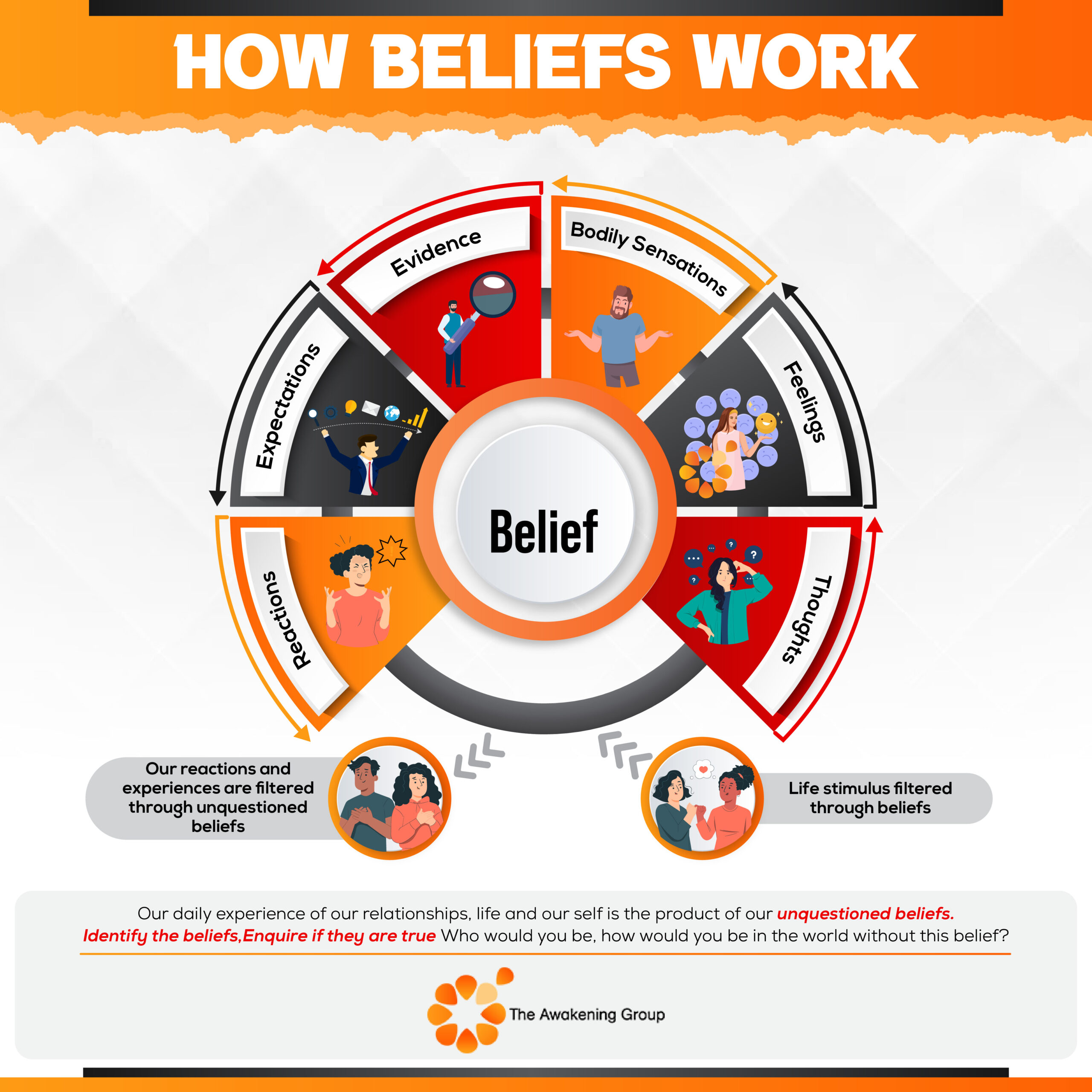
    As you can see from the diagram above, stimulus from our environment enters the brain and the neurological system and is filtered through our whole nervous system but also associative memory which has unconscious beliefs inherent in it. As it is filtered through the beliefs that we have taken on unwittingly so throughout our life, it creates feelings, reactions in the nervous system either signally to the body it is a threatening situation or all is well thus producing bodily reactions. Furthermore beliefs gather evidence to prove they are correct and filter out anything that does not support them. As our brain automates our environment very quickly to ensure we do not use too many resources in analysing and making decisions continuously, it then assumes the beliefs are true without questioning them, thus becoming transparent and in nestled into the subconscious, until they cause suffering. At this stage beliefs self generate their own internal emotional and sensory world within us, again with particular feelings, thoughts, bodily sensations and reactions in the nervous system, that then solidifies them to be correct. Beliefs are then normalised and we expect life, people, ourself to be our belief that we have taken on unquestioningly. To sustain the belief it continually gathers evidence to prove it is correct. Our reaction to life is then filtered through beliefs that no longer serve us and often cause conflict and suffering and in war, internally and externally!

    How To Change Beliefs that Cause Suffering?

    No matter how a belief was formed or how a belief works there is a very simple and elegant way of transforming them. Byron Katie in the late 80’s after years of depression and whilst in a Women’s centre, experienced an epiphany that led to her discovering how to lessen the effects of stressful thinking. Today this method is used worldwide and simply involves enquiring into a belief in such a way that the belief lets go of you.

    Enquiry Exercise:

    1. Take a moment to think of stressful situation.
    2. Ask ‘What would someone believe in order to experience these feelings, stress, sensations?’ Keep the statement simple. Write it down
    3. Take this belief and bring it to enquiry by asking:
      • Is it true? Really have a look in your heart to find whether the belief is really true as we are looking at reality here not what you think is true. See if you can find a Yes or a No, not a sometimes or maybe. Go deeper into really checking reality.
      • Can you absolutely know it to be true? In your heart of hearts can you absolutely know this to be true?
      • How do react when you believe this thought? What happens to you?
      • How do you treat yourself, others, life when you believe this thought?
      • Can you find any peaceful reason, in other words it doesn’t cause you stress, for holding onto the belief?
      • Can you find a reason to let the belief go? Don’t try to let it go!
      • Who or how would you be if this belief never occurred to you? What would you do without this belief?
    4. Turn the belief around to the opposite, then to ‘Myself and My Thinking’ or if the belief is about another to “Other”; that is how I do to the other what I believe them to be doing to me? Here’s how:
      • Belief: ‘I am not good enough’.
        • Opposite Turnaround: I am enough
        • Myself and My thinking: It is only my thinking that thinks I am not good enough
      • Belief: Sam doesn’t appreciate the work that I do
        • Opposite: Sam appreciates the work that I do
        • Myself and My thinking Turnaround: I don’t appreciate the work that I do
        • Other Turnaround: I don’t appreciate the work Sam does
    5. After each turnaround before you find the next one ask:
      • Where is that turnaround true in your life?
        • See if you can come up with at least 3 incidents where it is true if possible.

    We are building new neurological pathways as the belief lets go of you. Whether it is enquiring into the beliefs that cause shame ie ” I am bad’, ‘There is something wrong with me’ or beliefs around money, relationship, another persons’ behaviour, or our own self criticism the result is a whole new reality appears.

    When we take a moment to find where the ‘Turnarounds’ are true we get to see that reality is much kinder than our thinking. Not only that, we get to experience a deep sense of peace, joy and love inherent in being human, this is often under unquestioned beliefs that cause suffering. So who would you be without your stressful thinking?

    ————————–

    Workshops

    The Work of Byron Katie weekends are held throughout the year for more information and dates go to: https://awakening.theteamserver.com/lms/course/the-work-of-byron-katie/

    Resources

    Byron, Katie Loving What is little booklet

    Worksheets – Write it down, ask for questions and turn it around

    One Belief at a Time worksheet

    Universal Beliefs – Are these some of the beliefs that cause stress in your life?